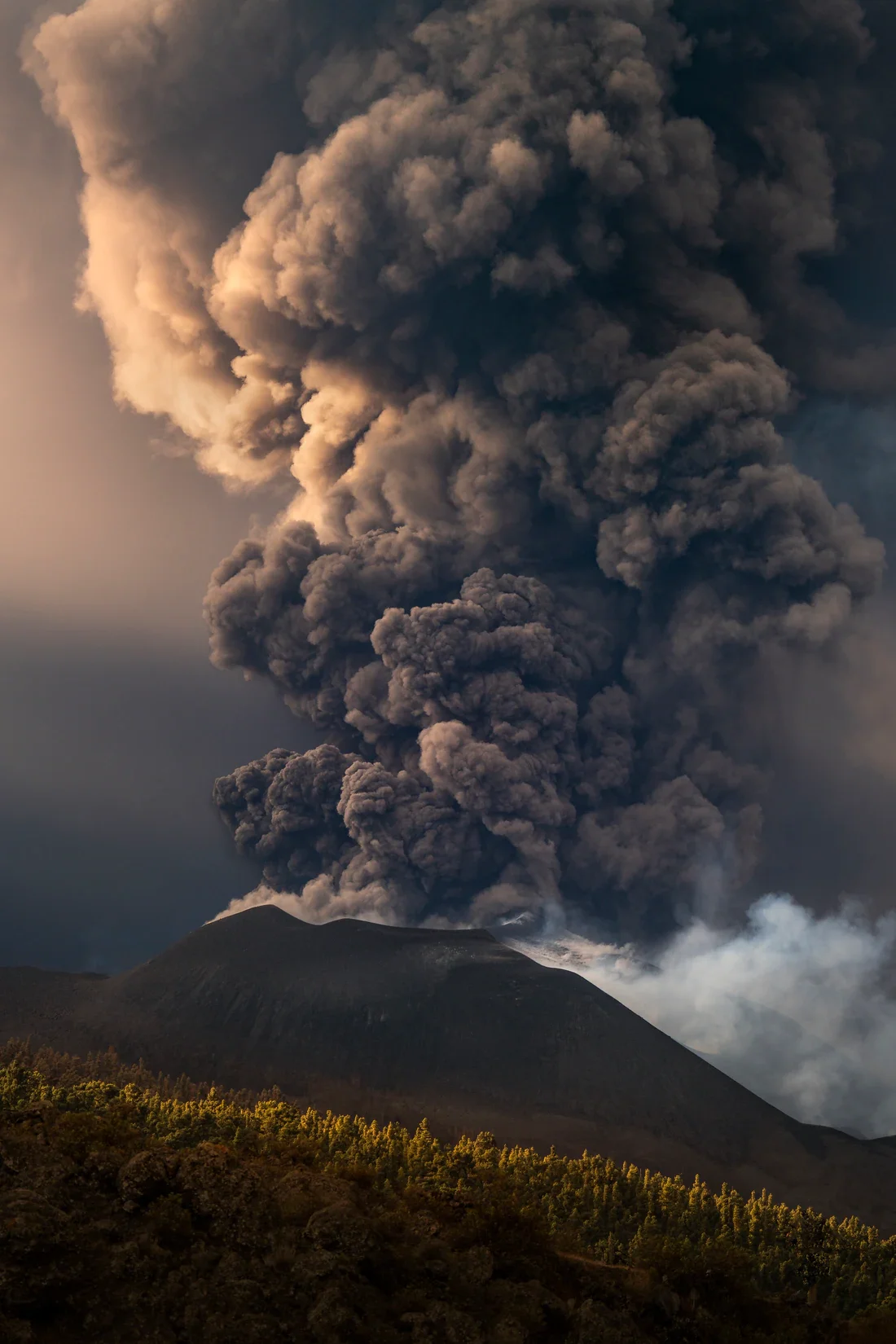
Large explosive eruptions are dominated by pyroclastic flows instead of buoyant plumes: insights from a global data compilation
WEBINAR
4th February 2026 19:00 GMT
by Dr. Alice Paine (Universitat Basel)
ABSTRACT
The dynamics of Earth’s largest, most voluminous eruptions (≥100 km^3 ejecta) are poorly understood. In this talk, I explore the question of whether these very large eruptions can be treated as scaled up versions of moderate volume historical eruptions, or whether they should be treated as fundamentally different Earth system phenomena. To examine this, I present a compilation of fall deposit and ignimbrite volume data for 74 explosive eruptions worldwide that are magnitude 4 or greater, and use this dataset to assess how material is partitioned into buoyant plumes versus pyroclastic density currents as a function of eruption magnitude. These results are then filtered by overall distance from seas/oceans, from which I focus in on the eruptions for which preservation of the deposits is as reliable as possible. After filtering, I show that the largest eruptions are dominated by ignimbrites and not fall deposits, implying that, co-ignimbrite plumes notwithstanding, there may be little or no buoyant plume component to eruptions of the highest known magnitudes. Finally, I demonstrate how this result is consistent with model simulations showing that the pyroclastic material produced during larger events is emplaced in density currents alone, and highlight important considerations for contemporary eruption simulations, the fate of volcanic gases relative to solid mass, and subsequent appraisals of the climatological and environmental impacts of explosive volcanism on Earth.
BIOGRAPHY
Originally from Hebden Bridge, a small town in West Yorkshire (UK), her interest in Earth Sciences began during my A-Levels. This prompted Alice to pursue a BSc in Physical Geography at the University of Leeds, giving her a new and life-changing perspective of Earth Sciences and Geography. Inspired by my time in Leeds, she embarked on an MSc by Research at the University of Durham (UK), under the supervision of Prof. James Baldini and Dr. Richard Brown. Here, Alice was first introduced to the disciplines of speleology and geochemistry, and her first experience of truly independent research also served to deepen her passion, and curiosity, for Quaternary volcanology and paleoclimatology. In 2024, she successfully defended her PhD at the University of Oxford (UK) after four years working under the supervision of Prof. Tamsin Mather, Prof. Stuart Robinson, and Prof. David Pyle, and was funded by the European Research Council (ERC) grant V-ECHO. Since August 2024, Alice has been based at the University of Basel as a post-doctoral researcher, and member of the SNSF Sinergia Project: “Holocene hydroclimate, drought dynamics and environmental changes recorded in multiple archives from SW Asia (MITRA)”.